|
How would an underwater nuclear explosion affect ships above it?
Author/Answerer: Derek Harkness,
Teacher at University of Science and Technology Liaoning
Answered: Apr 21 2018
LINK: https://www.quora.com/
How-would-an-underwater-nuclear-explosion-affect-ships-above-it
a-1946-07-25--Underwater--Operation-Crossroads--Baker Shot.htm
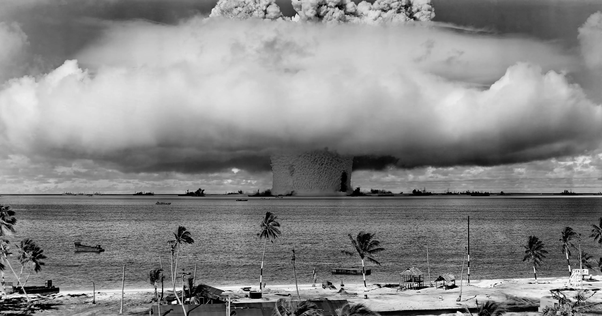
In 1945, the top Navy brass in the US had the exact same question.
Would an underwater nuclear device completely devastate their biggest and strongest battleships and carriers and what could the fleet do to mitigate the damage from such an attack?
The above picture is Baker Shot, part of Operation Crossroads, on July 25, 1946.
It was an underwater detonation -- the first ever underwater detonation -- with the device located 27 metres under the surface, within a total water depth of 55 metres. Above the device were about 80 or 90 vessels (left over from Able Shot of the 1st of July, which had been an above surface test) that included four obsolete U.S. battleships, two aircraft carriers, two cruisers, destroyers, eight submarines, numerous auxiliary and amphibious vessels, and three surrendered German and Japanese ships.
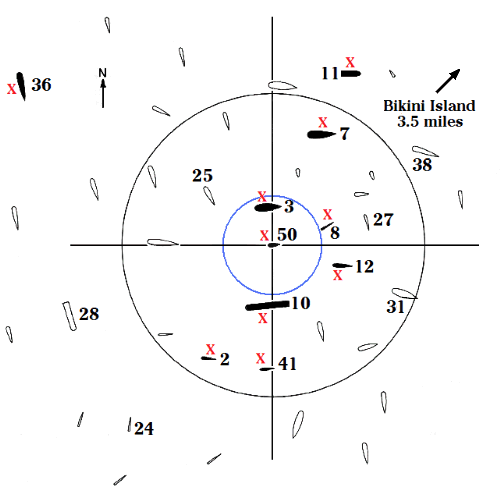
The above chart, grabbed from Wikipedia, shows the locations of some of the ships relative to ground zero in the test.
The red X's mark the 10 ships that sunk, the black circle is the 1,000-yard radius line within which all ships were seriously damaged. The smaller blue circle is the 330-yard radius of the crater left in the seabed. About half the ships involved are located outside of this diagram. Since the Baker shot was underwater, it was quite different in it's result to the previous Able shot.
In the Able shot, 5 ships were sunk and about 15 received severe damage.
Most of the damage was above the water line and the extent of damage depending on how the ship was orientated to the explosion. Ships that were broadside on, took the worst of the brunt while ships pointing bow or stern on faired better. In the underwater explosion of Baker, a fireball formed a huge bubble of gas that expanded rapidly, pushing the water outwards. This supersonic shockwave in the water easily crushed the hulls of nearby ships. As it expanded, the bubble slowed to about the speed of sound in water, which is 1600 m/s. This shock wave could be seen as a dark shadow in the water, known as a "slick", radiating out rapidly from ground zero and it is this that did the most damage to the ships.
A second shockwave of white water followed behind slightly slower.
This second wave is known as the "crack" and was less damaging. Within one second of the explosion, all the water from within 152 metres of ground zero was removed (bubble). About 2 million tons of water and seabed sand was lifted into the air. The column of spry reached 1,829 metres high and 610 metres wide. A few seconds later, the seawater started to rush back into the vacated space creating a tsunami. The waves of the tsunami reached the beaches of Bikini Atoll, about 3.5 miles away, with a height of 5 metres, and threw landing-craft onto the beach and covered them with sand. Next came the "base surge". This was a fine mist of water that rolled out relatively slowly, covering all the ships but.
The damage assessment found that 10 ships had been sunk.
The battleship Arkansas had been very close to the device when it detonated.
The massive ship was lifted right up and dropped bow first into the seabed. She then topped over and sank. Her superstructure was stripped away, the starboard hull was crushed, propellers ripped way and guns stripped off. The aircraft carrier Saratoga had been positioned near the blast. Her stern was lifted 13 metres into the air. She sank 7.5 hours later.
However, the biggest damage was done by the base surge.
This mist of radioactive spray that covered all the ships. The Baker shot was the first nuclear test to be done underwater.
Normally, air bursts would be almost self-cleansing. The superheated air that rises in the mushroom cloud carries much of the dangerous radioactive material high in the atmosphere. The fall out covers a very wide area but at a low dose. However, in the Baker explosion, the nuclear reaction interacted with the water creating about twice the number of free neutrons as previous tests. Those neutrons didn't blow into the atmosphere. They were captured by the water in the lagoon and so the mist of the base surge heavily contaminated all the ships with radioactive materials. During the first 6 days after the test, 4,900 men were sent to try to decontaminate the ships. They tried to scrub of the radioactivity with brushes, soap, lye, and water. It didn't work.
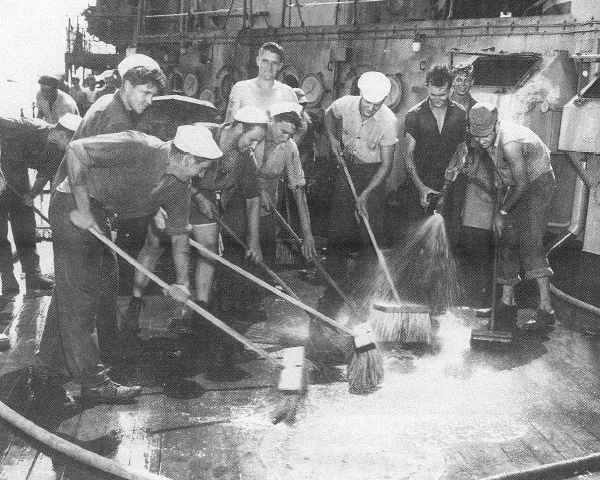
The explosion also created a small amount of radioactive sodium.
This sodium remained in solution in the water. It contaminated the ships.
Not only the ships used in the test but also the support ships and decontamination ships that entered the area later were contaminated.The decontamination exercise continued for 16 days before being terminated and was considered to be a failure. They were unable to remove the radioactive contamination. Colonel Warren, the Army colonel in charge of radiation safety for Operation Crossroads, concluded the entire effort was futile and dangerous.The entire test fleet was contaminated. They had planned to do another underwater test, Charlie Shot, in early 1947, but had to delay that test because there were no uncontaminated ships available to be used as targets. Charlie was eventually cancelled. A test similar to the planned Charlie shot was conducted 9 years later as part of Operation Wigwam. Only twelve of the target ships were lightly enough contaminated that they could be remanned and sailed back to the US. The destroyer USS Laffey, which had been a support ship, not a target, required sandblasting and repainting below the waterline.
COMMENT:
Size of the blast: 21-kiloton
There is no indication that any of the ships was directly positioned above the blast.
Simply, the blast would have released a bubble of air and steam which rising to the surface would have enveloped any ships immediately above. Responding to gravity, any such ship would have fell at increasing speed to the bottom of the bubble, in this case the ocean floor, and crashed. Immediately, the ocean water returning would have both crushed the wreckage further under quickly increasing water pressure, and, the water currents would have covered the remains with sand and debris.
IF any such ship, submarine, aircraft carrier contained a nuclear powered energy source, such would have potentially generated a secondary nuclear detonation depending upon the design of the reactor. Most modern (2019) marine reactors are designed to explode in such a mishap.
In addition, the explosion(s) would generate tsunami waves of size relative to the explosions.
|
|
Articles on the Internet are transitory.
The publishers may remove them, change sites, change URLs, or change titles.
For the purpose of maintaining an availability of these articles for you, it has been reprinted here with authorship maintained and coding simplified for error-free loading and minimal file size.
|
|